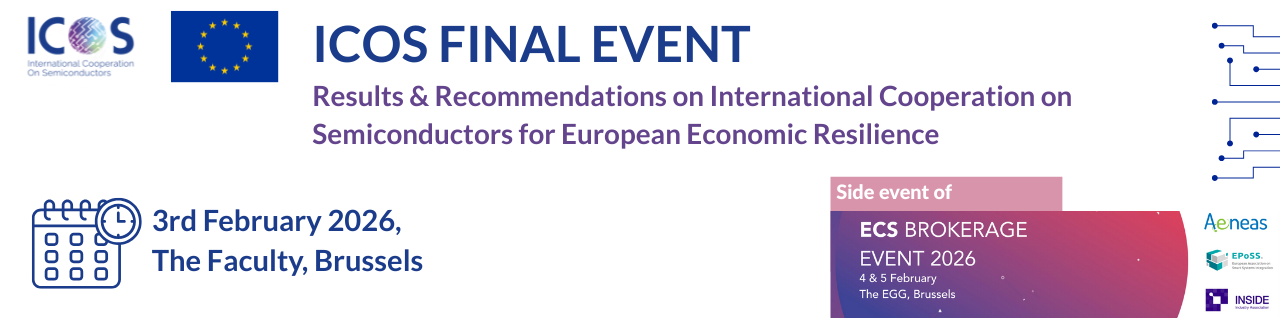
The ICOS team was delighted to welcome you on February 3rd at The Faculty, 3 minutes away from the building where the ECS Brokerage will be held
The semiconductor world is rapidly changing, and this brings along challenges for Europe and all other regions in the world. The mission of the European project ICOS (International Cooperation On Semiconductors) was to identify the needs and opportunities for international collaboration in this changing ecosystem.
International cooperation is indeed key for speeding up technological innovation, reducing cost by avoiding duplicated research, strengthening complex semiconductor value chains, knowledge exchange, manage risks due to the turbulent geopolitical context, overcoming gaps in standardisation and skill shortage, and is encouraged by the new strategies of leading semiconductor countries and is one of the objectives of the EU Chips Act.
The aim of ICOS was i) to implement, strengthen and develop the Digital Partnerships and Trade and Technology Councils in close cooperation with the European Commission, ii) to build balanced semiconductor partnerships with like-minded countries, iii) to set out cooperative framework on initiatives of mutual interest, iv) to identify and support the establishment of the most promising scientific international collaborations to overcome the main challenges in the Roadmaps, v) to organize matchmaking bilateral and multilateral events, vi) to support the growth of the Semiconductor industry in growing markets, vii) to strengthen Europe’s position in emerging technologies and global value chains in this area and to contribute to the EU Chips Act, Green deal and Digital Agenda.
In this event, the final ICOS results was highlighted, including i) an assessment of strengths and weaknesses across the semiconductor value chains within EU and in leading semiconductor countries, strategic dependencies, market growth, and cooperation opportunities, ii) the identification of the most promising emerging technologies for future applications, iii) the highlight of priority research topics for international cooperation, based on critical needs related to technologies for advanced computation and advanced functionalities, covering smart sensors, smart energy, energy harvesting for autonomous systems and semiconductor-based photonics, iv) the technological ecosystems and strengths in partner’s countries for possible future international cooperation, v) and the impact for EU.